


Breast cancer is the most common cancer among women worldwide – one in eight women will develop it in their lifetime. It doesn't only affect women with a family history of the disease: around 70% of all breast cancer cases occur in women without known risk genes such as BRCA1 or BRCA2.
With the DoctorBox Breast Cancer Risk Test (AnteBC), you can determine your personal genetic risk – based on a polygenic risk score derived from 2,803 gene variants. This article explains how the test works, who it's suitable for, and how you can use the results to actively shape your preventative care.
Cancer screening · Genetic prevention
Breast Cancer Risk Test:
Detect your genetic risk early
Breast cancer in Germany: The most important figures
Breast cancer is by far the most common cancer among women. However, if detected early, the chances of recovery are very good – making an individualized prevention strategy all the more important.
Approximately 70,000 new cases
per year in Germany
per year in Germany
1 in 8 women gets sick
during their lives
during their lives
~87% 5-year survival rate
with early diagnosis
with early diagnosis
70% without known
BRCA mutation
BRCA mutation
Why genetic screening is important
Breast cancer risk is not only influenced by rare, high-risk genes like BRCA1/2. Science has recognized that many common gene variants—each with only a minor effect on its own—can significantly increase or decrease the risk when combined. This polygenic risk score (PRS) allows for a personalized risk assessment for each woman.
What is a polygenic risk score (PRS)?
The polygenic risk score is a modern genetic tool that combines the effects of many individual gene variants to create an individual risk profile.
2,803 gene variants
The AnteBC test analyzes 2,803 so-called SNPs (Single Nucleotide Polymorphisms) – common genetic variants that each have a small influence on the risk of breast cancer.

Cumulative calculation
The effects of all analyzed variants are mathematically combined. This results in a score that represents the genetic risk compared to the average population.

Individual customization
The result also takes into account your age and ethnic origin – giving you a precise, personalized risk assessment.
BRCA vs. PRS – What is the difference?
BRCA1/2 are rare, high-risk mutations that significantly increase the risk of breast cancer (up to a 70% lifetime risk). However, they only affect about 5–10% of all breast cancer cases. The polygenic risk score, on the other hand, detects common variants found in the general population – and can also identify an increased risk in women without a BRCA mutation. The AnteBC test does not analyze rare BRCA mutations – it complements, but does not replace, a BRCA test in cases of family history.
Who is the breast cancer risk test suitable for?
The test is aimed at all women who want to learn more about their personal breast cancer risk and actively shape their preventative care – regardless of family history.

Women aged 30 and over
The test is validated for women between 30 and 75 years of age. It is particularly useful for women under 50, as regular mammography screening in Germany only begins at age 50.

With or without family history
70% of all breast cancer cases occur in women without known risk genes. The PRS can detect an increased risk even without a family history.

Health-conscious women
For those who want to act proactively: The test provides concrete recommendations on when and how often preventive examinations are advisable.

When uncertain about one's own risk
If you are unsure whether you belong to a risk group, the test can provide clarity and help you make informed decisions.
This is how the breast cancer risk test works
The entire process is simple and can be conveniently completed from home. In five steps, you will receive your personal risk profile with individual recommendations.
1
Order test kit
After ordering, you will receive the test kit discreetly by post – including all materials for the cheek swab, step-by-step instructions and a prepaid return envelope.
2
Take a sample at home
Sample collection is very simple – a cheek swab is painless and takes only a few minutes. The enclosed instructions clearly explain each step.
3
Return sample
Pack the sample in the enclosed envelope and drop it off at the post office. The postage is already paid – you will incur no further costs.
4
Receive results digitally
After the laboratory analysis, you will receive your results within approximately 6 weeks – including your personal risk score, 10-year prognosis and individual prevention recommendations.
5
Discuss with your doctor
Discuss your results with your doctor to develop a personalized prevention plan together. Optional: Video consultation with a doctor directly via DoctorBox.
+
Optional: Video consultation
For personal questions or a detailed discussion of results, you can book a video consultation with a doctor (one-time fee of €150).
What does your test result mean?
The report gives you a comprehensive overview of your genetic breast cancer risk – presented in an understandable way and with concrete recommendations for action.

Your personal risk score
You will learn how your PRS compares to the average population – divided into risk categories (low, average, elevated, high).

10-year risk of disease
A concrete assessment of the probability that you could develop breast cancer in the next 10 years – based on your age and genetic profile.

Relative risk
You can see how your risk compares to other women in your age group and the general population.

Individual recommendations
Specific guidance on when to start screening, how often examinations are advisable, and what preventive measures you can take.
Detailed medical report
Your results will be summarized in a comprehensive report, which you can also share with your doctor. This allows your medical team to integrate the results into your personal preventative care plan.
Advantages of the breast cancer risk test
The AnteBC test offers a scientifically sound way to understand your genetic breast cancer risk – convenient, safe and CE-certified.

Simple cheek swab
No blood, no doctor's visit – you can take the sample conveniently and painlessly at home with a simple cheek swab.

Scientifically validated
The test is based on extensive studies using data from the UK Biobank and the Estonian Biobank. The methodology has been published in scientific journals.

CE certified & GDPR compliant
AnteBC is approved as an in-vitro vascular device (IVD) in the EU and registered in the EUDAMED database. Your data is protected in accordance with the GDPR.
Personalized preventative care recommendations
You will not receive general advice, but specific recommendations for screening and prevention tailored to your risk profile.
Important information about the test
The breast cancer risk test provides valuable information – however, it is important to understand its capabilities and limitations.
What the test can – and cannot – do
- The test is not a diagnostic tool: it cannot diagnose breast cancer, but provides an assessment of genetic risk.
- High risk ≠ disease: An increased score does not mean that you will definitely become ill – it merely indicates a statistically higher risk.
- Low risk ≠ protection: Breast cancer can still occur even with a low PRS score. Regular checkups remain important.
- No BRCA analysis: The test examines common gene variants. Rare, high-risk mutations such as BRCA1, BRCA2, and PALB2 are not analyzed.
- Individual results: The result applies only to you personally. Family members must be tested separately.
- Science is changing: Genetics is constantly evolving. Risk models can change with new findings.
Note on the Genetic Diagnostics Act (GenDG)
In accordance with the German Genetic Diagnostics Act, you will receive written information about the purpose, procedure, and possible results before the test. After the test, you will receive your digital report with a personalized prevention plan. You can also optionally book a personal consultation via video call.
Frequently asked questions about the breast cancer risk test

Why is the test only recommended from age 30?
The risk assessment and clinical recommendations are validated for women between 30 and 75 years of age. In younger years, the absolute risk of breast cancer is very low, so the test would be less informative.
Do I need the test if there is no breast cancer in my family?
Yes, because 70% of all breast cancer cases occur in women without a family history. The polygenic risk score can also detect an increased risk even without a family history.
Does this test replace a mammogram?
No, the test does not replace preventative health checkups. However, it helps you decide when and how often such checkups are advisable for you personally.
How accurate is the polygenic risk score?
The AnteBC-PRS has been validated using independent data and demonstrates good differentiation between high- and low-risk women. However, it is a probability statement, not a diagnosis.
Should I also have a BRCA test done?
If there is a history of breast or ovarian cancer in your family, an additional BRCA test may be advisable. The AnteBC test does not analyze rare, high-risk mutations.
How long will it take to get the results?
The lab analysis takes approximately 6 weeks after we receive your sample. You will receive a notification as soon as your results are available.
Conclusion: Knowledge strengthens your preventative care
Breast cancer is the most common cancer among women – but also one of the most treatable when detected early. With the breast cancer risk test, you can understand your genetic risk and take action before symptoms develop.
The AnteBC test analyzes 2,803 gene variants and provides you with a personalized prevention plan with specific recommendations for your preventative care. Scientifically validated, CE-certified, and conveniently performed at home.
Order your breast cancer risk test now for €252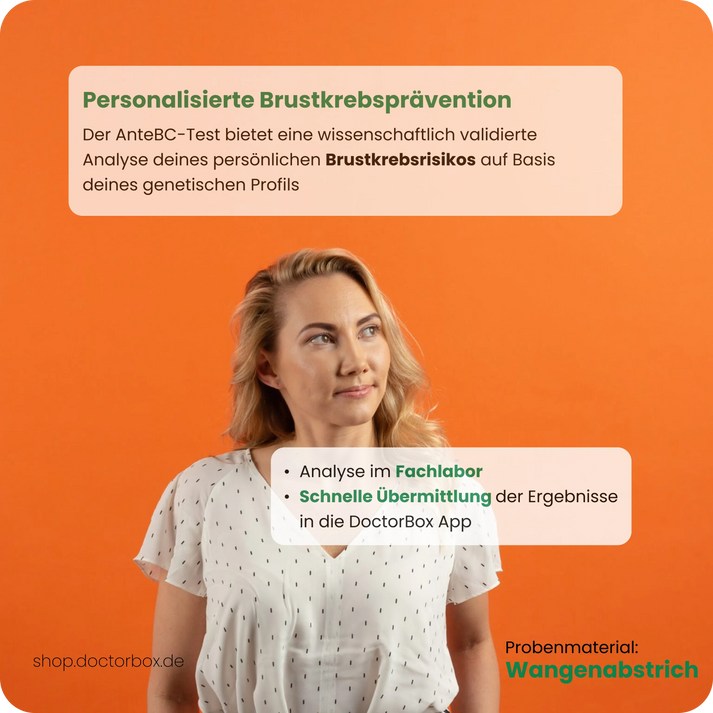
Scientific sources & further information
- Center for Cancer Registry Data – Breast Cancer in Germany
- Cancer Information Service of the German Cancer Research Center (DKFZ) – Breast Cancer
- Padrik P et al. Implementation of Risk-Stratified Breast Cancer Prevention With a Polygenic Risk Score Test in Clinical Practice. Breast Cancer (Auckl). 2023
- Mavaddat N et al. Polygenic Risk Scores for Prediction of Breast Cancer and Breast Cancer Subtypes. Am J Hum Genet. 2019
- AWMF S3 guideline: Early detection, diagnosis, therapy and follow-up care of breast cancer
- Antegenes – Scientific documentation on the AnteBC test


